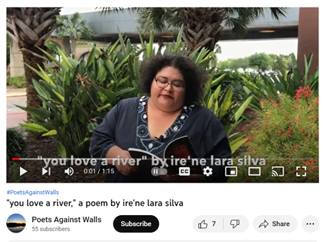
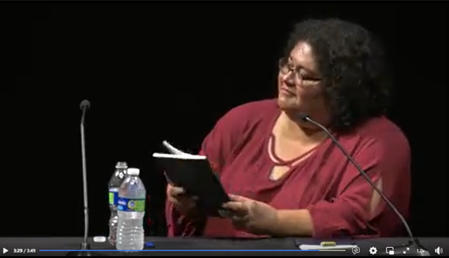
Link to “The Dream: Reflections on the Anniversary of Virginia Woolf’s Suicide”

Greetings, all:


Lots of good news lately. Last week I signed a contract with Aunt Lute Press. I’m happy to announce that they will be publishing my first short story collection, flesh to bone, later this year. More updates soon!

Also, I was named the Fiction Finalist for A Room of Her Own Foundation’s Gift of Freedom Award on March 20, 2013. I was invited to write a blog reflecting on the anniversary of Virginia Woolf’s suicide and the myth/reality of the tortured, abbreviated life of the female artist. My guest blog appeared last Thursday at http://www.aroho.org, but I also wanted to share it with you here.

These links will also give you more information about AROHO, the Gift of Freedom, and more info/guest blogs from Diane Gilliam, the recipient of the 2013 Gift of Freedom, and Florencia Ramirez, the Creative Nonfiction Finalist.


“The Dream: Reflections on the Anniversary of Virginia Woolf‘s Suicide”

By 6th Gift of Freedom Genre Finalist for Fiction, Ire’ne Lara Silva


http://www.aroomofherownfoundation.org/Irene-Lara-Silva_VW.php

On mastery…

**Note to readers: apologies for disappearing for a while there…and thank you for coming back or for visiting for the first time. My goal is to post monthly, at least from here on out…**

…I was catching up with Barbara Jane Reyes’ blog the other day….
http://www.barbarajanereyes.com/2013/01/15/viewing-jiro-dreams-of-sushi-reminds-me-of-some-things-about-poetry/#more-7588

And it made me want to respond at length….

First, I don’t think the majority of Americans have the concept of mastery as BJR was  discussing/defining it. This society (dominant American society) seems to only value mastery that has brought fame (certain actors, chefs, etc.) or mastery that demands a high price (master craftspersons, for example). There’s no appreciation for mastery without money or fame. And it especially has no appreciation for mastery that comes with long-term effort or sacrifice. Which is why America idolizes the stories of the young—of inborn talent or natural beauty suddenly recognized. It makes the story more interesting if they’re somehow otherwise an underdog (born poor or of the wrong skin color) and maybe they have to take on some Rocky Balboa-training montages, but for the most part, it’s not a talent or skill that took decades or an entire life to develop.

BJR’s post brought to mind the year I was taking t’ai chi classes—ten years ago already. I was rapturously in love with it, with learning, with how strong I was becoming, with how, even in sixteen movements, I could feel my body singing. And I loved that it was so difficult. It was interesting, as an adult, to try to learn something that wasn’t easy and that I had no natural talent for. Within minutes of beginning, I’d feel my body shaking uncontrollably. But I kept at it—even after a year, my body still shook, but I was so much stronger and I hope, more graceful.

Often, too, it seemed that there were parallel lessons that I could apply to poetry, to writing. Our Sifu often spoke about American impatience—how often his students were dismayed that they were only taught one movement at a time and had a week to practice it before returning and learning another. He spoke of masters in China who would have a student learn one movement and practice it for a year before returning to learn another—because they understood it took time and practice and dedication to even begin to truly master something. I also remember that he often quoted a proverb about how long it took to do some things/tasks/projects: “if not one year, then five, if not five years, then ten.” Other students often asked him how long it would take to get to the next belt or to a black belt or how long it would take to be able to teach. He’d give them such a look!

I had all kinds of timelines…how long it should take me to write a poem, write a story, publish a book, win this or that. But I’ve always found that poems, stories, books tell you when they’re done—it never works the other way around. With t’ai chi, there was always the option to stop—to stop going to classes, to stop learning, to stop practicing—or to go on. With writing, there’s also always a choice: stop or keep going. Stop or keep working with a piece until it ‘felt’ real. Stop or keep trying to go deeper. Stop or refuse to give up. Stop or create my own definitions of success. Stop or create my own definition of what it meant to be a writer.

I did eventually stop going to t’ai chi—a car accident and finances interrupted my progress—but I still dream of returning to it. Though writing has had all kinds of obstacles, I’ve never truly put it down. Sometimes I’ve had to lay in wait, sometimes I’ve had to fight my way back to it, sometimes I’ve had to hunt it down—but as the years have gone by, it’s the work I’ve clung to the most tenaciously.

A piece from BJR’s post: “But before this becomes about amateurs versus professionals, I want to add what Lisa Jarnot wrote at the Poetry Foundation blog: “If I have something to give as a teacher (collaborator? conspirer? facilitator?), it’s the message that a passion for poetry, plain and simple, can triumph over the banking model of education.” I want to say this “banking model,” is the opposite of the love/passion for art, and the apprenticeship-mastery model that Jiro Dreams of Sushi presents to us. In this “banking model,” while you may be working towards a profession, I don’t think you are necessarily striving for mastery, but consenting to be shaped into a commodity/product that can be plugged into the economy.”

And whether poets/writers know it or not…I think that’s a choice they have to make: early on and then over and over again…marketability or soul? And if you choose soul, then you also have to choose how much soul—the skin-surface level of your soul? The depth of its flesh? The depth of its bone? Or the depth of its red, red marrow? And whatever you choose necessitates further mastery—not as defined by prizes or publication, but as defined by—by what, by who?

I’d be afraid to begin to pin down an “objective” definition of mastery. I wouldn’t trust a checklist of criteria. By its very nature, I think mastery can only be recognized when it’s seen, when it’s felt. However, that also means that not everyone will be able to recognize it. Recognition would require some level of appreciation and discernment and knowledge and engagement. And that may begin to sound like I’m saying that only the educated can appreciate or pursue mastery—but I’m not. Recognition that comes only from education is a cold and lifeless thing—a thing that says “this ____ has been judged to be good and therefore everything else must be compared to it.” The most important recognition comes from engagement at the level of soul. That moment when you see some work of art or hear some form of music or read a line of poetry that so completely enraptures you that it feels as if your whole body has been made into a bell and then rung…and everything in you resonates and you will never be what you were before. Engagement at that level of soul recognizes mastery.

The first place I ever felt that was listening to music…listening to Mexican rancheras. Listening to Lucha Villa and Lola Beltran…Jose Alfredo Jimenez and Vicente Fernandez…Cuco Sanchez and Cornelio Reyna….and later, Chavela Vargas…

From them, I’ve come to form my own definition of my goals as a writer. I want to plumb the depths. I want to find the song. I want to sustain rawness. I want my writing to tear me up and to tear up my readers—the way that rancheras leave me crying or laughing or breathless or holding myself back from throwing grito after grito into the air…

All the singers or singer/song-writers I just named had long, long careers…and one of the things I find most fascinating about them is how they sustained a certain quality of rawness…their performances were always emotionally alive, their hearts were in their voices. They weren’t always smooth or polished and in fact, that rawness always served the song. Like Lorca relates in his “Play and Theory of the Duende”, La Niña de Los Peines had “to tear apart her voice, because she knew experts were listening, who demanded not form but the marrow of form, pure music with a body lean enough to float on air. She had to rob herself of skill and safety: that is to say, banish her Muse, and be helpless, so her duende might come, and deign to struggle with her at close quarters. And how she sang! Her voice no longer at play, her voice a jet of blood, worthy of her pain and her sincerity…”

And that brings me to my last thought…that the only way the individual artist can pursue mastery is by defining for themselves what mastery is—not  a self-serving definition that incorporates the ‘banking model’—but a unique definition that speaks to the artist’s aesthetics and that creates an ongoing challenge for the artist herself.

After that, we have to trust that those who can discern mastery will do so.

With many thanks to BJR…

Our relation to revolution…(2nd in an ongoing series)

[I’m re-posting Pablo Miguel Martinez’ response to my last blog below because I wanted to share his reply with everyone…and also wanted to respond to it at length. A few notes: I believe he’s also referencing a few comments that were made on my Facebook page…the Eduardo mentioned below is Eduardo Corral….and we’re all members of CantoMundo…)

Pablo Miguel Martínez on July 26, 2012 at 5:10 pm said:

Thanks so much for your thought-provoking, post, ire’ne. You touch on several issues that have gnawed at me for longer than I care to admit. So here are my two rusted centavos…

Revolution. Hmm. How are you/we defining the term?

“Revolution begins with the self, in the self,” says Toni Cade Bambara. I think that’s as fine a place to start as any. When I go back to the etymology of the word revolution, I begin wondering about what to turn over, what to recycle, what to renew in my thinking-feeling-doing as an educator, as a poet, as a lover of possibility. Most days I think we (with that pronoun I embrace all poets, writers, thinkers) have lost the revolution of letters. Cynical though that appears, let me explain where it comes from: as an instructor of English at a Hispanic-serving institution and at a two-year college where the majority of the student population is African American and Mexican American, I can tell you that our young people are increasingly distanced from ‘literature.’ (The single quotation marks are snarkily [?] intentional.) The public school system, as we know, does not encourage students to think critically, and if a student can’t think critically, she certainly isn’t going to excel as a writer. Also, this classist paradigm (’cause we know this does not apply to students in affluent school districts) suggests students aren’t being required to read literature in ways that build and strengthen their analytical skills. I start the first class meeting of every composition course I teach with this basic maxim: Writing is thinking. This, sad to say, is a major revelation to most of my students. So, my first question: For whom, then, are we writing? I know, I know, this is a tired, hoary question. But remember, “revolution,” in its strictest sense, compels us to turn the ideas over in our minds.

Eduardo, I know you’re frustrated by younger-generation poets and writers who are passive where change is concerned. (“Be the change that you wish to see in the world,” said Gandhi.) But my teaching experience tells me that most undergraduates (with the exception of those at first-tier research institutions, perhaps) feel/have been disempowered, so they’re at a loss as to how they should take their first steps on the path to Change.

On a related note: far too much time and energy has been devoted to bashing MFA programs—that’s wholly understandable, since they are culprits here (I hasten to add that I’m a product of such a program). But there is, of course, a reason for this: a vast majority of these programs extrude a kind of writing that’s palatable to mainstream publishers, contest administrators, and critics. The irony is that genuinely revolutionary writing is too often derided by the MFA machine as facile, or, worse, dismissed with that deprecating descriptive, “accessible.” Make it new, MFA faculty constantly echo Pound’s imperative. (The irony here is that what’s truly new doesn’t fit the template many of these faculty employ, so it’s cast aside.) But here I think of my college students, who yearn for work that speaks directly to them. Work with which they identify, work that moves them, work that doesn’t condescend to them; work that is, in other words, accessible to them. Another Toni Cade Bambara quote: “The job of the writer is to make the revolution irresistible.” But we can’t make revolution alluring if we’re removed from those who will join us in revolution, however constructed and enacted.

Recently, a not-for-profit literary organization found itself at what I understand to be a challenging, soul-searching juncture: one faction of its Board felt that the organization should focus more sharply on literacy efforts, since the organization is located in a city with a painfully persistent literacy problem. The other faction believed it should continue its focus on supporting poets and writers and “literature.” As if the two are mutually exclusive! A revolutionary idea: you can’t have a vibrant, dynamic, inclusive literature without literacy. This is so obvious. And yet, a writer friend, when I shared this scenario with her, accused me of being simplistic. ¡Ay, caray!

ire’ne, you demarcate writing along generational lines, which I realize is a standard, often useful practice. However, as someone who’s deep in the thickets of middle-age without a book and still struggling to find his place in the ‘community’ of poets and writers (there are those queer single quotes again!), it’s something I’m sensitive to/about. We expect younger poets and writers to chart new literary terrain—that’s what the young do, after all. But that’s a one-handed, lopsided revolution. If, as bell hooks exhorts African Americans to do, we return (a revolution!) to love as a path to healing wounded environments, we have to work together—women and men, queer and straight, young and younger. If I have to compartmentalize aspects of my life in order to revolutionize, count me out. As a gay man, I had to do that for too much of my life: it’s O.K. to be ‘out’ in this context, but not in that one; it’s all right to hold hands in this neighborhood, but you risk life and limb if you do so in this one. Some days, the most revolutionary, the most transgressive thing my partner and I can do is hold hands in public. So let’s hold hands, I say.

There are many paradoxes here, chief among them the fact that writing is a solitary pursuit, but revolution requires collective, active bravery. I am inspired by the many who understand—and live—that paradox.

I don’t know, ire’ne, but in this case revolution may require nothing less than a redefining of the very term literature. We need to turn it over, sass it, caress it, prod it, and at the end of the day, tuck it in and turn it over in its restlessness. In the meantime, I’ll keep returning to your ideas, questions, and burnished, burr-under-the-saddle commentary. Te mando calurosos abrazos desde Appalachia.


My response:  

Mil gracias, Pablo Miguel, for your in-depth response…I am glad these issues have been gnawing at you  because I think they’ve been gnawing away at a lot of people/poets and I wonder if we haven’t buried  our ideas re: ‘revolution’ because those ideas aren’t ‘professional’, because we have become distanced from our idealism, because revolution doesn’t seem to have a place in the real world…

One of the issues that came up re: revolution at one of the CantoMundo platicas…(believe Ethelbert Miller brought this up)…that the language of revolution had been co-opted by marketing/advertising. That we no longer had the language with which to discuss/ignite/enact revolution. What do we call it? What does it look like? Macondo used the phrase, “writers interested in social change,” but that doesn’t encompass those who are pushing against language borders and aesthetic boundaries…those who are involved in historical reclamation or spiritual (r)evolution…and so on…nor does it speak to the issue of the critique of power…

And how do we speak revolution to people who associate ethnic/racial/gender/sexual revolutionary groups with exclusion? LGBTQ-gente that were excluded from the Chicano movement, women of color that felt excluded from the white feminist movement, and so on? But at the same time, how do you speak revolution without making people choose one identity or one injustice-to-right over another?

I’m interested in what you call the revolution of letters…do you mean the potential of literature to empower disenfranchised students/communities? The potential to inspire/imagine change in the world?

I agree with you about the public school system and that “students aren’t being required to read literature in ways that build and strengthen their analytical skills”…one of the reasons that the Arizona/Tucson school district situation is so heart-breaking. Demonstrably, the Mexican American Studies classes were having a huge impact on those students.

How many times and in how many other places have classes like those been lost? I was shocked to find out in the mid-90’s after I’d gone away to college that there’d once been Mexican American studies classes in South Texas (95% of the population is Mexican American) in the 70’s and 80’s. By the time I was in high school, those classes, their books, and all memory of them had completely vanished from memory—I don’t know if they died out due to lack of funding, an intentional attack, or both. I had to go to college in New York to read literature by people of color, to read David Montejano’s Anglos and Mexicans in the Making of Texas to understand anything about where I’d come from, to find Gloria Anzaldua’s and Cherrie Moraga’s This Bridge Called Our Backs to open up the world for me.

Who do we write for? I think, a fuerzas, I have become a great believer in gateways. I have to believe that one thing leads us to another: one poem to another, one book to another, one performance to another, one poet to another.  There is a huge need, yes, to connect students with the literature that speaks to them—so they can begin their own linking series of gateways—they need to be drawn in—by love, by identification, by inspiration, by curiosity….

But then I have to ask, what is it that teachers are opting to teach—unrelate-able classics? Inaccessible contemporary work? Books that have been vetted by prizes and prestigious presses?

A few things I wanted to say about MFA programs—though upfront, I will say I have never attended one…I don’t object to them on principle, but I do object to the perception that one isn’t a ‘real writer’ without an MFA.

I know a lot of writers who do have their MFA’s—they run the gamut from shell-shocked and rendered-silent former writers to empowered and productive writers to talented, well-received writers who do not understand how much of the sense of entitlement and dominant society attitudes they absorbed and went on to perpetuate. Some writers have said they encountered cooperative and supportive structures; many more talk about the atmosphere of competition.

I wonder if it possible for MFA programs to foment revolution—for all the reasons you stated, Pablo Miguel…but also because they are artificially constructed communities. Maybe ‘artificial’ is not the word I want…maybe ‘external’ is closer…because it seems writers are drawn to them by factors like prestige, cost, faculty, funding…

In the absence of MFA’s, I would say writers are drawn to each other when they hear each other…and are attracted by each other’s work…drawn together by friendship and love…living in close community with each other…and in that atmosphere, support and challenge are integral parts of the community…I had this. This is part of what formed me as a writer—to support wholeheartedly without envy or competition—to challenge meaning, language, emotion freely, in order to strengthen other writers not tear them down. We celebrated each new work, the old works, shared books and poems and thoughts with absolute enthusiasm.

I don’t know how MFA’s teach writers community…much less how to build the community with the skills necessary to gestate revolution…especially if the dis-connect from those who will join us in the revolution becomes automatic, becomes an integral part of the privilege of education…

(On the subject of that non-profit literary organization…since the founder asked for input over Facebook, I gave my two cents there as I am a huge admirer of the organization and the work it does…I think they ran into the problem of feeling that literacy and literature were competing for their attention and resources—as opposed to feeling that the two supported each other…I tackled it from an administrative point of view as I can barely imagine the headache it must be to write grants, file reports, attract funders, etc. for such a varied program. My solution was to appoint two executive directors, one for the literacy side, one for the literature side…while still sharing resources, office space, staff, and fundraising efforts…so that the connection still exists, but focus could be strengthened…)

Lastly, because I am running out of time, but not because I couldn’t go on for a while longer—I want to thank you for your words about my demarcation along generational lines…I did it to simplify matters for a point I wanted to make that I never got around to…but also, reading your words, I realize that point is null anyway….because whatever generation/time/place we began writing, what is important is that we writers are all here NOW, writing NOW, living in THIS time…and whatever we have believed, believe, or will come to believe about revolution or whatever language we create to speak revolution—we are (to quote June Jordan and the Hopi)…the ones we’ve been waiting for…

abrazos pa’ ti,

ire’ne

on revolution, freedom, and writers of color…

some fragmented thoughts/reflections after CantoMundo 2012…

I read bell hooks’ Remembered Rapture more than a decade ago…RR isn’t my favorite of her books, I’d be much more likely to recommend Teaching to Transgress, Killing Rage, Wounds of Passion, Talking Back and so on… but there was a line that stopped me in my tracks. Apparently, I was the only one hit this hard by it cause I can’t find it anywhere online, even after scouring through a hundred of bell hooks’ quotes…

With apologies for my very rough paraphrasing, she wrote that someday literary work by women of color would not be revolutionary solely because it was written by women of color…but because of what they were writing…

We have had revolutionary women of color writers: Toni Morrison, Audre Lorde, Leslie Marmon Silko, Maxine Hong Kingston, Theresa Hak Kung Cha, Gloria Anzaldua, Cherrie Moraga are just a few of the names that come to mind—all writers who blew me away when I was in college and changed the parameters of my world.

Don’t get me wrong—I am very happy about the explosion of women of color writers everywhere—happy there are those writing Chica-Lit. And I’m glad there are people of color writing novels that the publishing world considers more ‘mainstream. ’ It’s great that those presses are willing to publish and promote those works. A part of me always rejoices to see Latino/Asian surnames or to see photos of writers of color on fliers for readings, posters for conferences, etc.  I know that every publication, every presence was fought for by the writers that came before us.

But I can’t help it that I want more…I want more revolution, I want more challenge, I want more power and rage and re-creation…

Recently, at CantoMundo 2012, our keynote speaker, E. Ethelbert Miller, spoke about the Black Arts Movement and how critics had removed/erased its revolutionary component…which left me wondering about Chican@/Latin@ literary work–it was also born in the heat of revolution…in the heat of protest against injustices…and in the revolutionary act of loving/claiming ourselves and our heritage(s).

What is our relation to revolution?  And by “our” I mean those of us who are the next couple waves of writers—from age 22 to those writers in their 30’s and 40’s who are still labeled ‘emerging’ and those who are newly arrived at ‘established.’ Can POC/Latin@ literary work exist without revolution?

I want to support all Latin@ poetry, all work by writers of color—but I have to acknowledge that different writers and their work have a different relation to revolution. In a recent conversation with a  non-CantoMundo friend, we talked about an inclination for work that ‘spoke to power,’ that critiqued/dismantled the dominant society and all forms of injustice.

I find it difficult to unilaterally support work that casts Latin@s as passive victims in the world, work that ‘re-inscribes the dominant paradigm’ (I can’t help the quotes—but I can’t find any other way to say this), and work with problematic power relations that objectify/exoticize Latin@s as the (powerless) Other. Sometimes it seems to me that there are more areas of sympathy and overlap between writers who write in close relationship to revolution and power than there are among writers of a specific racial/ethnic group…

But I also want to bring up another thought that has been heavily on my mind since CantoMundo:

Also about a decade ago, I read a P&W interview with Li-Young Lee.  This is also roughly paraphrased—Lee said that one of the things that oppression threatened was our connection to the divine. What I took away from that was that it could be an act of revolution/rebellion/freedom to insist and cultivate that connection—to write from that connection to the divine and thereby resist historical and contemporary oppression.

And in the years since, I’ve come to think that this applies to many other areas as well….that oppression has threatened our connection to our emotions, our own healing, our own stories, our own aesthetics.

There was something I heard at CantoMundo and that I’ve heard echoed in many places by many women of color—an anguish I don’t hear voiced by any other group—that I wanted to speak to…our fear that our poetry, our aesthetics, our desarollo (our development as poets), will take us to a place where we are not connected to our non-poet communities…and perhaps, not easily & identifiably tied to revolution?

We are always pushing ourselves as poets/writers, as women of color—but isn’t it the work of freedom, the responsibility of freedom— to cultivate those connections that oppression has always threatened? What does resistance look like? What does freedom look like? More importantly, what does it sound like?


on the necessity of nakedness…

Note: Apparently, I used up all my June blogging-mind working on this little essay which aired June 17, 2012 on the radio show, Words on a Wire, as a poetic license segment.

Link to UTEP Radio: 
http://ktep.org/program_detail.sstg?id=235

Link to show which features poet Javier O Huerta: 


Link to access Words on a Wire archives: 
http://www.wordsonawireradioshow.blogspot.com/

…on the necessity of nakedness…

With one book out and three more working to find their way into the world, it came to me that I should articulate what my real desire as a writer is…the reason I keep writing in the face of rejection and delays…the reason why the seams between my life and my writing are sometimes invisible and sometimes ragged…

Not the project-related reasons that I detail for grant applications, not the marketable reasons I list for potential presses, not the personal reasons why I–a 37 year old, round, diabetic, college dropout, former migrant student, daughter of illiterate parents, childless, single, mostly lesbian, indigenous Mexican American woman of color– persist at writing…

Not the reasons why I had to write this poem or this story or that novel, what they were meant to explore or what they say about our personal and communal mythologies, our survival strategies, or our lost histories—but the real reason I write…

And while some writers came to write their lives, their family stories…and some came to write for the voiceless, and some came to tell truths, and some came to stretch their imaginations to the limits…

I came to the page to be naked…to strip away pretense and surfaces, to strip away prevarication and confusion… I want only what is real. I want the essence. I want to see into the heart of things…into the skin and muscle and marrow of things…

I want to write what frightens me, what endangers me, the words born of my entranas, the words born in the heat of my blood. I want to see how close I can stand to the precipice, how far I can peer down…I want to write myself stronger so that I can stand even closer and look down even further…I want to strip down to the level of soul and breath and then write from there…

All the writers I love, all the writers that have taught me how to be a writer did so in those moments, those pages where they were naked…Novelists like maria luisa bombal, juan rulfo, jeanette winterson, leslie marmon silko, marguerite duras, toni morrison, cormac mac carthy…

There’s an aliveness in nakedness—an energy that is light and heat and sound and impact—that reverberates—that pulses—that leaves both reader and writer trembling and roaring…This place of nakedness is where I feel the most alive, the most aware, the most charged with the potential of creation.

I’ve always loved these lines from John Donne:

Batter my heart, three-personed God; for youAs yet but knock, breathe, shine, and seek to mendThat I may rise and stand, o’erthrow me, and bendYour force to break, blow, burn, and make me new.

I want my heart battered by what I read. I want my heart battered by what I write. I want to be made anew. It may sound violent, but to be broken open is not necessarily all pain and loss. To be broken open can be another kind of freedom. And the most direct route to nakedness–Nakedness as catharsis. Nakedness as transformation. Nakedness as not necessarily the truth, but a truth.

And while most of what I’ve written and have yet to write will serve only to document all my failed attempts to get at the heart of things, one day I won’t fail… one day I’ll write something as naked and raw as the most soul-ripping of ranchera songs…like lucha villa singing, I’ll write ferocity and tenderness and blood and freedom and nakedness all at once….ajua!

on creativity, suppression, and freedom…

So it’s been 105 days since I stopped writing poems like my life depended on it. 75 days since I decided I’d get back to work on my novel. 45 days since I blogged about actually beginning again. A month since I figured out I was going to take what I’d written apart at the seams. Two weeks since I figured out where I’d messed up. A week since I said, that’s it. Today’s the day.

But I still haven’t written a word.

I know all about ‘fallow’ seasons…about writing yourself to exhaustion and needing time to recoup…about that curious sense of build-up, when you feel tiny flames flickering in your belly and the words start bubbling upwards…I know about waiting, sitting at the desk and listening…

And I know too about procrastinating and about prioritizing everything else above writing and about being afraid to pin down the vision in your mind…

In some ways I do feel I’ve been shedding fruitless ideas about things and expectations and all the mental clutter/crap that can get in the way…and I’ve been tackling projects and to-do’s all over the place…but when I find myself in a place like this one…limbo without explanation…delay not born of necessity…then I have to ask what’s behind it…

A few years ago, my friend the poet Celeste Guzman Mendoza said something that struck me. She spoke about the gratitude she felt for having writing in her life—how grateful she was to be a poet/writer—how grateful she was to work with words—how grateful she was for this gift in her life, how it fed her, how it sustained her, how it gave and gave and gave. It struck me because I’ve so rarely heard writers talk about gratitude.

I too am grateful. At the heart/center/bottom of it all, I am grateful to have writing in my life…to write…to listen…to create…

When I wrote my first story at age 8, I couldn’t find any paper in the house. I cut up a brown paper bag to make pages and write. When my younger brother Eddie was buying candy and toys with his allowance or gift money, I was buying packs of pens and notebooks.

My parents were migrant truckdrivers, so we moved often, sometimes seven or eight times a year. In south texas, we lived in our house and I had my own bedroom, but everywhere else, we rented motel rooms or one bedroom apartments or two bedroom houses. Sometimes it was five of us, sometimes it was six or seven of us. I remember we were allotted one box or suitcase of clothing and one box of ‘stuff.’ Mine was heavy—filled with books and notebooks and pens and drafts of poems and stories…

Often, I shared a mattress on the floor with my siblings and kept a notebook under my pillow. I used to read and write in the dark, with nothing but the streetlights streaming in from outside. When we lived in motel rooms (my parents in one bed and my younger brothers in the other), I’d sneak up from my place on the floor between them and go write in the restroom. I’d put towels all around the door to keep the light from disturbing anyone.

Fairy tales, vampire stories, horror stories, a lot of science fiction and fantasy, the occasional romance, and a few other strange things that I could barely classify…stories, chapters, synopses, lists of characters, bits of dialogue…they came pouring out.

My mother encouraged me…she bought me a manual typewriter at a flea market. I lugged it around even though it was heavy and went ‘ping’ whenever I came to the end of a line. I loved it to pieces. I named it ‘Henry’ though I don’t remember why now.

One day when I was fifteen, we were living in Oklahoma, and I was at home taking care of my brother Moises. That summer, we listened to Roy Orbison, made friends with the cantinera neighbor and her daughter, and had many adventures walking to the Dairy Queen and the library and the gas station and the Gibson’s. But that particular day I wasn’t expecting my parents until dinnertime, so I’d taken out my typewriter and put it on the table we ate on. I’d also laid out my pens, a rough draft of a story I’d marked up in red, my thesaurus, some music cassettes, and who knows what else.

My father came home unexpectedly in the middle of the day. He saw me typing away and flew into a rage. He threatened to break my typewriter and burn all of my papers. I don’t remember anymore what I screamed at him or what I threatened, but I remember I put my body inbetween him and the table. He slapped me and yelled some more. I collected my papers and my typewriter in one sweep of my arms and put them on the floor out of the way. I forget why he’d come home, if he’d come to find a receipt for an auto part or for his checkbook or for what, but he left before long.

That night, I stayed awake knowing I’d run away before I let him destroy my writing.

I’ve written in other places about how my mother was an artist who channeled her creativity into the work of surviving…into filling our lives with moments of beauty…her gardening, her sketches, her meals, the blankets she made, the dresses she could create with and without patterns…for a woman with a second grade education, she could converse about anything…her memory was a marvelous thing…

But at the same time, she never had the chance to dedicate herself wholly to the things she loved most to do…there was no perception in her upbringing that a person—much less a woman– could dedicate themselves to their chosen art…life was about having a family and working….she lived with a lot of shame for her dark skin. she loved pale yellow but never wore it because she’d been told it made her look even darker (and uglier).  Whenever I wear it, I think of all the times she never did. She used to tell me she loved the way I laughed when I laughed loud because she’d never felt free to do so. I never heard her sing above a murmur because my father’s family had shamed her out of it. In my early twenties, it felt so important to laugh and sing and take up space and be free—because she had never been or felt free.

What I haven’t written about was my father’s dreams. One of them was about wanting to be a singer, heading a conjunto band, singing in a different place every night. He said that he used to sing with his friends when they were all teenagers, but that his friends had needed beer or liquor to get up enough courage. I used to beg him to sing and make those little mambo yells. The mambo yells he’d make, but singing was much more difficult to get out of him. A few times, I got a few lines out of him. When I asked him why he hadn’t become a singer, he’d say he never would have been able to remember all the songs a singer would need to know. That’d it be impossible for him to even learn them all since he didn’t know how to read. His schooling was so patchy, he never made it past the first grade. As children, he and his younger sister, left school to work all day in the fields.

I don’t know what particular mix of frustration and shame and poverty and abusive experiences drove my father to be the man he was—given to sudden rage, sudden violence…pre-occupied with material possessions and power over others….but also, a man driven to suppress the creativity of others…

We grew up knowing nothing was safe. He regularly attacked my mother’s garden. These trees were too overgrown, those trees weren’t in the right place…He’d hack off branches until the trees looked like shorn and naked sheep. He didn’t like the ferns or the cannas and so my mother had to pull them out. They were gorgeous and green and overflowing. Someone told him prickly pear cactus harbored rats, and so he commanded my youngest brother to cut them down. When they grew back, my father burned them. There were no rats.

Drawings and papers and molding clay weren’t safe left out anywhere. My older brother and my youngest brother weren’t allowed in the kitchen even though they felt the call to cook much louder than I ever did. Any creative thing my brother Moises did, my father quashed—in his eyes, creativity was ‘suspect’—serving only to confirm my father’s suspicions that his youngest son was, in fact, gay.

Since I was a girl, what I chose to do was mostly unimportant—unless it kept me from the housework/babysitting/chores that took up most of my time, as long as I didn’t take up any physical space in the home, and as long as it didn’t affect my father’s comfort.

Other people talk about writer’s block and the Internal Critic or the Internal Agent (the Internal  Agent being the voice that says ‘no one’s ever going to publish this…it’s not marketable…you’re never going to make a dime…you’re not a real writer if you can’t make your living as a writer)…but I think I’m barely coming to the understanding that what I’ve always been fighting is the Internal Suppressor…the voice that prioritizes everything else above writing, that eats away at my conviction that my chosen art deserves everything I pour into it, that ties into my (this sounds over-dramatic, but let’s call things what they are)…self-destructive patterns and occasional depressions and threatens to torpedo my drive/ability/energy to stay with my writing…

There’s an essay I love by Jeannette Winterson where she speaks about the body’s natural impulse to heal… …and she says there’s a corresponding natural impulse in the psyche to heal and to create…

I believe that creativity is the healthy impulse of conscious humans: not war, not lust, not consumption, not greed, not drunkenness, not apathy, not suppression, not self-destruction…in my poet-skewed world-view, I usually think most of the world’s bitterness, futility, isolation, and trauma could be alleviated if everyone got to work on a poem or a painting or a garden or a song.

But this is not a world of conscious humans…this is not a world of healthy impulses…In a culture—whether a national culture or a family culture—where people follow materialism rather than creativity,  alcohol and drugs are used for entertainment and to ‘numb the pain’, where self-destructive behaviors are considered the norm, it makes sense that creativity and the artist’s life would be devalued, dismissed, derided. The self-destructive culture seeks to suppress the healthy impulse to create.

Which leads me back to the beginning.  Creativity is essential to my desire to be a conscious/healthy human. So what’s going on here? I know I don’t give a shit what the ‘culture’ thinks I should be doing or how I should be doing it. I’ve been an independent adult for decades now. Time may be at a premium, but if all I do is write for half an hour a day or if all I write is one sentence a day—then I’m still writing, I’m still creating. So what’s stopping me?  There’s no one left to suppress my creativity but myself.

And maybe, in the end, this is what will push me out of this limbo’d moment—naming the Suppressor and remembering the girl I was. How thrilled she would be to have more than enough paper. To have a safe and permanent place in her home to put her poems and stories. To write on a computer. To have written so many pages. To have a book with her name on the cover. To have other books on the way.  I don’t think she ever even imagined the pleasure of other people reading her words or the possibility of knowing other writers.  She loved to have a whole white page in front of her. Loved the feeling when the first word was written and when the last word was written. And for her, every word in between thrummed with freedom.